A Complete Dining Room Size Guide

A dining room rug can make your space feel warmer, more inviting, and beautifully put together. It brings the dining table and chairs into one cohesive arrangement while adding softness, color, and texture to the room.
But choosing the right size can be surprisingly tricky.
How big should a rug be under a dining table?
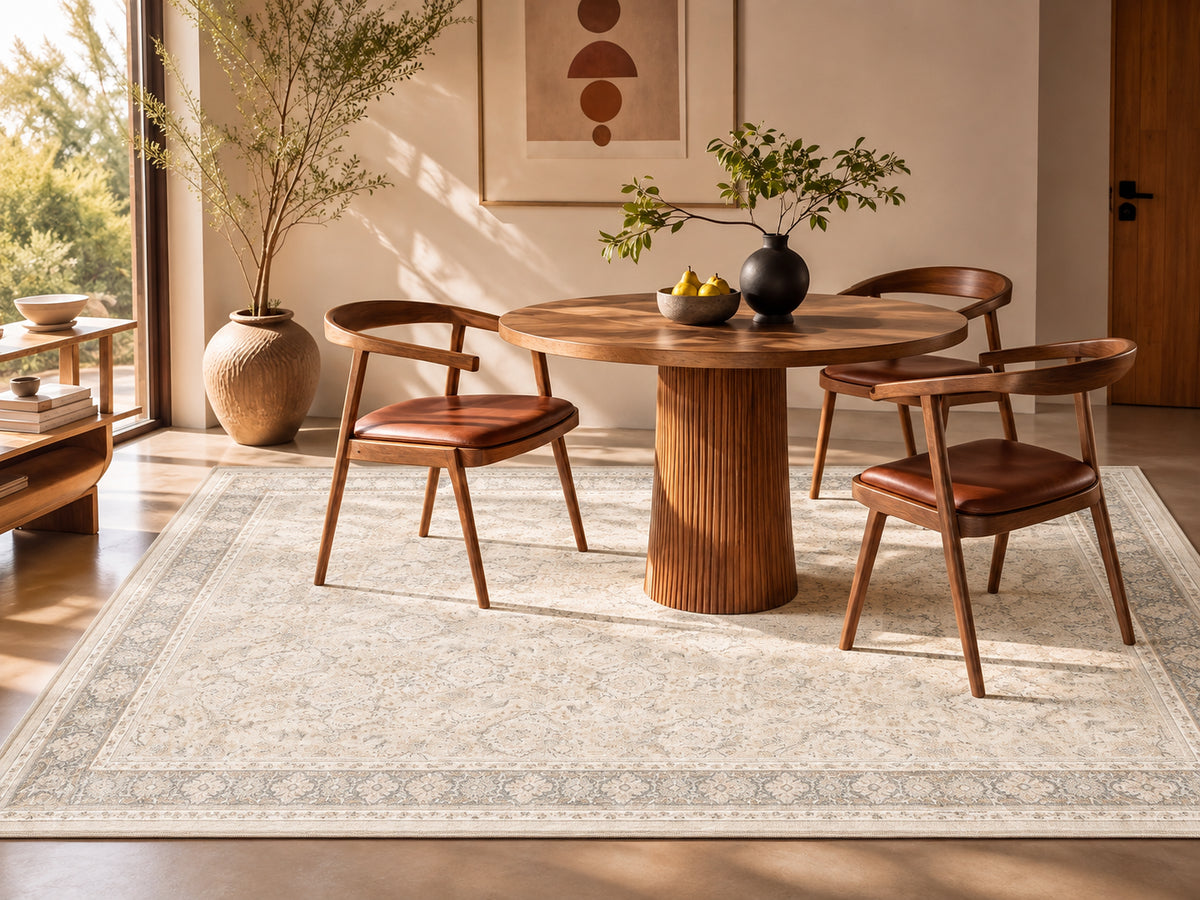
As a general rule, your dining room rug should extend at least 24 inches beyond every side of the table, with 24–30 inches being a practical starting range for many dining spaces. This gives dining chairs room to move while helping keep their legs on the rug when pulled out.
For many standard dining tables, an 8' x 10' or 9' x 12' rug works well. However, the ideal size depends on your table's dimensions, shape, chair placement, and available floor space.
In this guide, we'll cover how to measure for a dining room rug, choose the right size for different tables, and avoid common decorating mistakes.
The Golden Rule: Leave 24–30 Inches Around Your Dining Table
The most important dining room rug sizing rule is to allow enough space for your chairs.
Unlike a living room rug, which mainly anchors stationary furniture, a dining room rug needs to accommodate movement.
Every time someone sits down or stands up, the dining chairs move backward.
If your rug is too small, the back legs of the chairs may slide off the edge, making them harder to move and potentially causing the rug to bunch.
For this reason, aim for 24–30 inches of rug extending beyond the table on each side.
Why 24 Inches?
Twenty-four inches provides a useful starting allowance for pulling out many dining chairs.
However, some chairs require more room, particularly those with deeper seats or larger frames.
When Should You Choose 30 Inches?
Consider extending the rug approximately 30 inches beyond the table if:
-
Your dining chairs are large or upholstered
-
People frequently pull their chairs far from the table
-
You have enough room for a larger rug
-
You want a more spacious, balanced appearance
The best way to confirm the measurement is to pull out your dining chairs as you normally would and measure how far they extend.
How to Measure for a Dining Room Rug
Before choosing a rug, measure your dining table and the space around it.
Step 1: Measure Your Dining Table
For a rectangular table, measure its length and width.
For a round table, measure its diameter.
Step 2: Add 48–60 Inches to Each Dimension
Because the rug should extend 24–30 inches beyond each side, add a total of 48–60 inches to both the table's length and width.
For example, if your dining table measures 36" x 72":
-
Table width: 36"
-
Table length: 72"
-
Add 48" for a 24" extension on each side
-
Minimum target rug size: 84" x 120"
That's equivalent to a 7' x 10' rug.
Since 7' x 10' isn't always a standard size, an 8' x 10' rug may be a practical choice, depending on your chair dimensions and the room layout.
Dining Room Rug Size Formula
Rug length = Table length + 48–60 inches
Rug width = Table width + 48–60 inches
This gives you a useful starting point before considering the room's overall dimensions.
Dining Room Rug Size Chart
Here's a quick reference for common dining table sizes.
| Dining Table Size | Suggested Rug Size | Notes |
|---|---|---|
| 30" x 48" | 6' x 9' | Works for some compact 4-person tables |
| 36" x 60" | 8' x 10' | Comfortable choice for many 4–6-person tables |
| 36" x 72" | 8' x 10' | Provides approximately 30" at the sides and 24" at the ends |
| 40" x 84" | 9' x 12' | Good option for many 6–8-person tables |
| 42" x 96" | 9' x 12' | Provides approximately 33" at the sides and 24" at the ends |
| 48" round | 8' round | Allows 24" around the table |
| 60" round | 9' round | Allows 24" around the table |
These measurements are guidelines. Always check how far your dining chairs move when pulled out.
What Size Rug for a 4-Person Dining Table?
A four-person dining table is common in apartments, breakfast areas, and smaller dining rooms.
Depending on its shape, a four-person table may measure approximately:
-
30" x 48"
-
36" x 48"
-
36" x 60"
-
36–48" in diameter for round designs
For many rectangular four-person tables, a 6' x 9' or 8' x 10' rug can work.
A 6' x 9' rug is particularly suitable for compact rectangular tables when it provides enough clearance for the chairs.
For a larger four-person table or a more spacious arrangement, an 8' x 10' rug may offer better coverage.
Can You Use a 5' x 7' Rug Under a Dining Table?
Sometimes, but it is often too small for a typical four-person dining arrangement.
For example, a 30" x 48" table placed on a 5' x 7' rug would leave only:
-
15" of rug at each side
-
18" at each end
That is less than the commonly recommended 24" clearance.
A 5' x 7' rug may work for a very small table with compact seating, but always test chair movement before choosing it.
What Size Rug for a 6-Person Dining Table?
Six-person dining tables often measure around 60–72 inches long, although dimensions vary by design.
For many six-person rectangular tables, an 8' x 10' rug is a popular choice.
For example, a 36" x 72" table on an 8' x 10' rug provides:
-
30" of rug beyond each long side
-
24" beyond each short end
This creates a balanced arrangement with practical space for chair movement.
If your table is wider, longer, or has particularly large chairs, consider moving up to a 9' x 12' rug.
What Size Rug for an 8-Person Dining Table?
Eight-person dining tables generally require more space.
Many rectangular eight-person tables measure approximately 84–96 inches long.
For these arrangements, a 9' x 12' rug is often a suitable starting point.
For example, a 42" x 96" table placed on a 9' x 12' rug provides:
-
33" of clearance along the sides
-
24" at each end
This helps accommodate chairs while creating a cohesive dining area.
If your table is particularly large or has substantial upholstered chairs, measure the actual chair clearance before purchasing.
What Size Rug for a 10-Person Dining Table?
A ten-person dining table may measure 96–120 inches long or more.
For these larger arrangements, you may need a rug measuring:
-
10' x 14'
-
12' x 15'
-
Or another size based on your table dimensions
For example, a 48" x 120" table requires a rug at least 96" x 168" to provide 24 inches on every side.
That's equivalent to an 8' x 14' minimum.
A 10' x 14' rug would provide additional width while maintaining the 24-inch allowance at the ends.
The exact size depends on the table, chair dimensions, and room layout.
What Size Rug Goes Under a Round Dining Table?

Round dining tables can create a softer, more conversational atmosphere.
When choosing a rug, you can use either a round or rectangular shape.
Round Rug Under a Round Table
A round rug emphasizes the table's shape and creates a visually balanced arrangement.
For example:
| Round Table Diameter | Suggested Round Rug Diameter |
|---|---|
| 36" | 7'–8' |
| 42" | 8' |
| 48" | 8'–9' |
| 54" | 9'–10' |
| 60" | 9'–10' |
Rectangular Rug Under a Round Table
You don't have to choose a round rug for a round table.
A rectangular rug can work beautifully, especially in a rectangular dining room or an open-concept layout.
For example, a 48-inch round table can fit comfortably on an 8' x 10' rectangular rug, with generous clearance on all sides.
The most important factor is that the chairs remain supported when pulled out.
Should a Dining Room Rug Be Bigger Than the Table?
Yes.
A dining room rug should generally be significantly larger than the tabletop itself.
If the rug is only slightly larger than the table, chairs may catch on its edges whenever someone sits down or stands up.
A larger rug also creates a stronger visual connection between the table and chairs.
Instead of appearing as separate furniture pieces, the entire dining arrangement feels like one intentional space.
Should All Dining Chairs Stay on the Rug?
Ideally, yes—even when pulled out for normal use.
When dining chairs move partly off the rug, the difference in surface height can make them harder to slide.
This is especially noticeable with thicker rugs.
Keeping the chair legs on the rug helps create smoother movement and a more consistent seating arrangement.
However, chair dimensions vary, so the standard 24-inch guideline may not be sufficient for every dining set.
Before purchasing, test the actual chair movement using painter's tape to mark the rug's proposed dimensions on the floor.
How Much Space Should Be Between a Dining Rug and the Wall?
The rug should fit comfortably within the room without making the space feel crowded.
In many dining rooms, leaving approximately 12–18 inches of visible flooring between the rug and surrounding walls can create a balanced appearance.
However, this isn't a strict requirement.
Smaller rooms may have less clearance, while larger rooms may have more.
The priority is to ensure the rug works with both the furniture and the room's circulation paths.
If a rug large enough for the dining chairs would extend too close to walls or doorways, reconsider the table placement or overall layout.
What Type of Rug Is Best Under a Dining Table?
Size is important, but material and construction also matter.
Dining rooms are naturally exposed to:
-
Food crumbs
-
Spilled drinks
-
Chair movement
-
Foot traffic
-
Everyday messes
For this reason, low-pile, easy-clean rugs are often practical choices.
Low-Pile Rugs
Low-pile rugs generally make it easier to move dining chairs and vacuum away crumbs.
They also tend to be more practical than very thick, fluffy rugs beneath dining furniture.
Washable Rugs
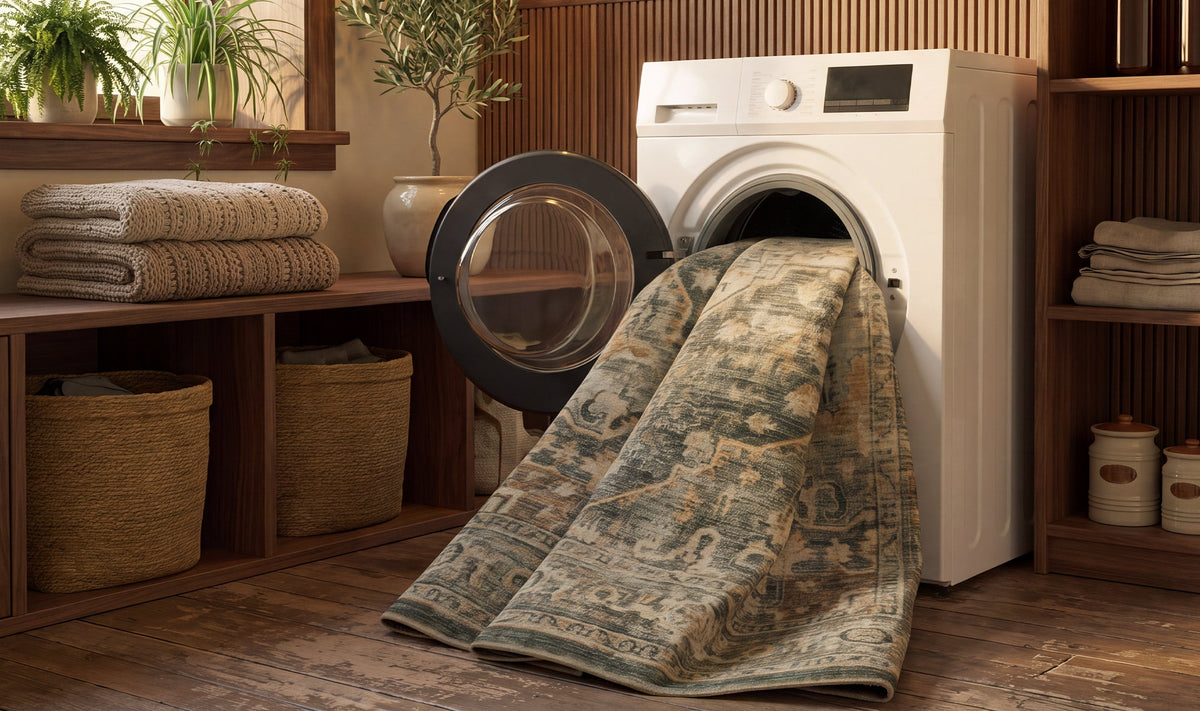
Machine-washable rugs can be especially useful in dining rooms where spills happen regularly.
MontVooRugs washable area rugs feature a soft, low-pile surface, machine-washable care, and integrated non-slip backing.
These features make them practical for family dining spaces, particularly in homes with children or pets.
Patterned Rugs
Patterns can help make everyday crumbs or minor marks less visually noticeable between cleanings.
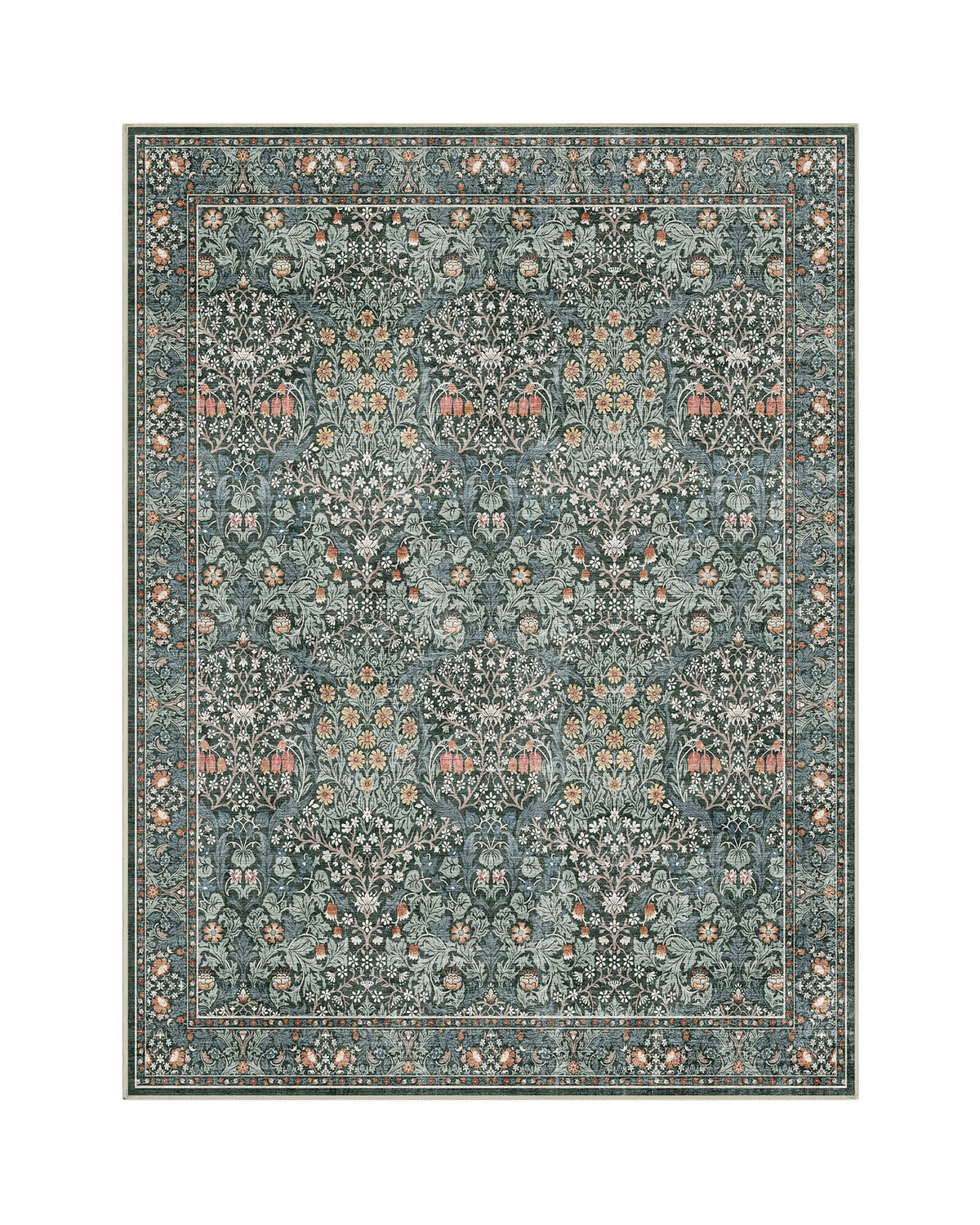
Vintage-inspired florals, distressed patterns, and subtle abstract designs can all work beautifully in dining rooms.
How to Choose a Dining Room Rug Color
When you choose a rug color, it should complement the dining table, chairs, flooring, and surrounding décor.
For a Wooden Dining Table
Wooden dining tables pair beautifully with:
-
Beige
-
Cream
-
Muted green
-
Warm brown
-
Vintage-inspired patterns
These combinations create a natural, welcoming atmosphere.
For a White Dining Table
A white dining table works well with:
-
Soft gray
-
Beige
-
Blue
-
Green
-
Colorful vintage designs
A patterned rug can introduce personality into an otherwise simple dining area.
For a Black Dining Table
Black dining furniture creates strong visual contrast.
Consider:
-
Cream
-
Ivory
-
Warm beige
-
Muted abstract designs
-
Vintage floral patterns
A lighter rug can soften the overall appearance of dark furniture.
Common Dining Room Rug Size Mistakes
Choosing a Rug That's Too Small
This is the most common mistake.
A rug that barely extends beyond the table may look attractive when chairs are tucked in but become impractical when people sit down.
Forgetting to Measure the Chairs
The table dimensions alone don't tell the whole story.
Pull out the chairs and measure how much space they need.
Ignoring the Room Size
A large rug may fit the table but interfere with doorways or walking paths.
Always measure the surrounding room.
Choosing a Thick Rug
Very thick rugs can make dining chairs harder to move.
Low-pile construction is often more practical.
Forgetting About Extendable Tables
If your dining table has extension leaves, consider how often you use them.
A rug that fits the table in its smaller configuration may become too short when the table is extended.
Ignoring Everyday Cleaning
Dining rooms experience spills and crumbs.
Choose a rug that suits your household's cleaning needs.
FAQs About Dining Room Rug Sizes
How much bigger should a rug be than a dining table?
A dining room rug should generally extend 24–30 inches beyond every side of the table to accommodate dining chairs.
Is an 8' x 10' rug big enough for a dining table?
An 8' x 10' rug works well for many four- and six-person dining tables. For example, it provides 24 inches of clearance at the ends of a 72-inch-long table and 30 inches along the sides of a 36-inch-wide table.
What size rug goes under a 6-person dining table?
An 8' x 10' rug is a common starting point for many six-person rectangular tables. Larger tables or chairs may require a 9' x 12' rug.
What size rug goes under an 8-person dining table?
A 9' x 12' rug is often appropriate for an eight-person rectangular dining table, depending on its exact dimensions.
Is a 5' x 7' rug too small for a dining table?
For many standard four-person dining tables, yes. A 5' x 7' rug often doesn't provide the recommended 24-inch clearance for chairs.
Can you put a rectangular rug under a round dining table?
Yes. Rectangular rugs can work well beneath round tables, especially in rectangular rooms. Just make sure the rug extends far enough for chair movement.
Should dining chairs stay on the rug when pulled out?
Ideally, yes. Keeping chair legs on the rug helps prevent them from catching on the rug's edges during normal use.
Should a dining room rug match the shape of the table?
Not necessarily. Round rugs can complement round tables, while rectangular rugs can work beneath both round and rectangular tables. Room proportions and chair clearance are more important.
What is the best rug for under a dining table?
A low-pile, easy-clean rug is often a practical choice. Washable rugs can be particularly convenient for family dining spaces.
How far should a dining room rug be from the wall?
Approximately 12–18 inches of visible flooring can create a balanced appearance in many rooms, but the ideal spacing depends on your room layout.
Final Thoughts
So, how big should a rug be under a dining table?
Start by measuring your table, then add 24–30 inches on every side to allow room for dining chairs.
For many homes:
-
A 6' x 9' rug works for some compact four-person tables.
-
An 8' x 10' rug suits many four- to six-person tables.
-
A 9' x 12' rug works well for many six- to eight-person tables.
-
Larger dining tables may require 10' x 14' rugs or bigger.
But remember, these are starting points.
The right rug should accommodate your actual chairs, fit the surrounding room, and complement your furniture.
A properly sized dining room rug does more than look beautiful.
It makes the entire dining area feel connected, comfortable, and ready for everyday meals, family gatherings, and everything in between.
Related Articles
Find the Right Dining Room Rug at MontVooRugs
A dining room rug should feel beautiful without making everyday life more complicated.
MontVooRugs washable area rugs combine soft, low-pile comfort with easy-clean construction and non-slip backing, making them a practical choice for dining spaces.
Explore vintage, floral, and modern designs in sizes suited to a variety of dining room layouts.